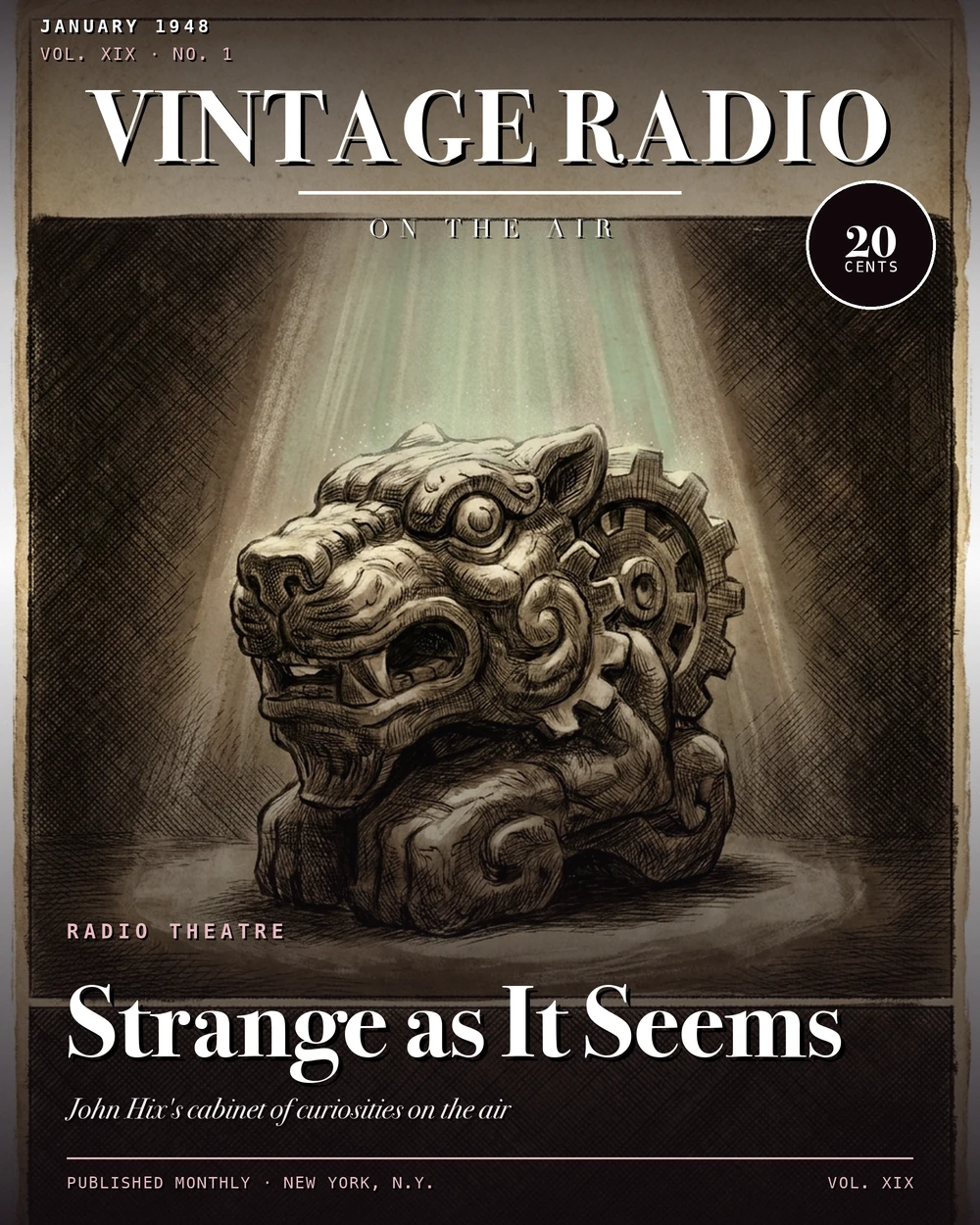
Strange as it Seems
A Rival to Ripley
When Time magazine sized up John Hix in May 1929, it put the matter plainly: "Astounder Ripley, after nine years, does not seem quite so astounding as fresh Astounder Hix." Hix was twenty-one years old. He had been a nationally syndicated cartoonist since age twenty, signed to McClure Newspapers in December 1927 as the youngest such artist in the country. Strange as It Seems debuted as a comic strip on March 28, 1928, in fifty newspapers — a single panel of unusual events, people, and places, much like Robert Ripley's Believe It or Not! but newer, fresher, and gaining ground fast. By 1930 the strip had a full-color Sunday edition and ran in eighty papers. At its height it was syndicated in over thirteen hundred, with editions reaching China, England, and Japan.
Hix held himself to a verification standard most newspapers would envy: every published fact required a minimum of three sources, and every cartoon carried the line, "If you doubt this, write for proof to the author." The competition with Ripley defined his career across every medium he entered. When Warner Brothers began releasing Ripley's Believe It or Not! film shorts in May 1930, Universal Studios signed Hix to a counter-deal. Thirty-nine Strange as It Seems shorts followed between August 1930 and May 1934, produced by Jerry Fairbanks and Manny Nathan, scripted by Hix himself, and narrated by an actor named Gayne Whitman. The films played in over six thousand theaters. At the 1939 New York World's Fair, Hix and his brother Ernest won the rights to operate the Strange as It Seems exhibit; Ripley responded by opening his Times Square Odditorium nearby.
Radio was the natural next front.
The Don Lee Years
The earliest documented radio run began on March 22, 1935, as a fifteen-minute program on the Columbia–Don Lee Coast network, sponsored by Ex-Lax and airing three nights a week — Sunday, Wednesday, and Friday at 7:45 PM, shifted an hour earlier during summer daylight saving time. By late September the Sunday broadcast was dropped, and a year later the schedule moved to Tuesday and Friday nights. The host was Gayne Whitman, the same voice that had narrated the Universal film shorts. Producer-director Cyril Armbrister and music director Felix Mills rounded out the team, a unit that would prove durable enough to reassemble more than a decade later.
The show was a promotional engine as much as a program. In 1936, Ex-Lax sponsored a booklet of Strange as It Seems stories, free to any listener who wrote in to the station. Eastern Color Printing put out the John Hix Scrapbook that December, with a second volume the following year. The radio program, the newspaper strip, the films, the books, and the World's Fair exhibit all pointed at one another, each version of the brand selling the next. The first radio run wrapped at the end of December 1938, comprising fifty-three episodes.
The CBS Run
When Strange as It Seems returned on August 17, 1939, it had moved up in the world — half an hour on CBS, Thursdays at 8:30, with Palmolive Shave Cream picking up the tab. The host this time was Alois Havrilla, who had announced for Jack Benny in 1934–35 and for Paul Whiteman before that. In 1935 Havrilla had received the American Academy of Arts and Letters Medal for Good Diction and been named the country's best radio announcer, and that pedigree shows in the assignment: a program built on improbable facts needed a voice that could deliver them straight, without nudging the listener to disbelieve. The CBS run totaled seventy-two half-hour broadcasts before ending on December 26, 1940.
A shorter return engagement followed from November 10, 1946, to April 13, 1947 — twenty-two episodes back in the original fifteen-minute format, Sunday nights at 7:30. Then in 1947–48 the program came back one last time as a transcribed series, fifteen minutes again, distributed to stations outside the network-clock system. Gayne Whitman returned as host. Cyril Armbrister returned as producer-director. Felix Mills returned to write the music. After more than a decade and several network homes, the same three men closed out the franchise they had launched on Don Lee in 1935.
The runs documented by researchers account for somewhere under two hundred broadcasts. But a newspaper account of John Hix's death quoted his brother Ernest as saying that over six hundred radio programs had been produced under the Strange as It Seems name. The gap between the two numbers suggests a great deal of broadcasting history that has yet to surface.
John Hix
Hix was born June 17, 1907, in Huntsville, Alabama, graduated from Greenville High School in May 1926 — there is a plaque on the school's Wall of Fame — and moved to Washington, D.C., where the Washington Herald paid him fifteen dollars a week as an editorial cartoonist. He studied at the Corcoran School of Art on the side and produced a daily one-column strip called Hicks by Hix for King Features, which led to the McClure deal and to Strange as It Seems.
During World War II he worked with the Office of Emergency Management, incorporating seventy ideas into the comic to support the war effort. On June 5, 1944, he collapsed and gashed his head in front of a Washington hotel. He died of myocarditis the next morning — June 6, 1944, D-Day — at age thirty-six. His brother Ernest took over the feature. Ernest was killed in the crash of a private plane in Los Angeles on September 18, 1948. Ernest's widow, Elsie Huber Hix, ran the business and wrote the strip herself until 1963, when she handed it off to her son Ernest Harmon Hix Jr., who produced it with his wife Phyllis until the strip ended in 1970. A hardback Elsie wrote in 1945 and its paperback edition each sold over half a million copies.
The Two Voices
The two hosts of the radio program had very different careers, but each was a natural fit for the material. Gayne Whitman — born Alfred D. Vosburgh in 1890 — had appeared in more than two hundred films between 1904 and 1957, played the title role in Chandu the Magician on radio, narrated Lassie, and announced for Paducah Plantation and Adventures by Morse. He had narrated the Universal Strange as It Seems shorts before stepping behind the radio microphone, which made him about as inside-the-franchise as a host could be. Whitman died of a heart attack in Los Angeles on August 31, 1958.
Alois Havrilla brought a different résumé. Beyond the Benny and Whiteman shows and the diction medal, he had worked as a narrator for Universal, Paramount Pictorial, and Pathé, and held a long list of staff positions at New York–area stations as commentator, announcer, narrator, and musical-program host. He died in Englewood, New Jersey, on December 7, 1952. Between the two of them, Strange as It Seems had voices who could sell a strange fact with absolute conviction — which, on a program where the whole proposition rested on the listener buying that the world really was as odd as the announcer claimed, was the entire job.